Press Release
FOR IMMEDIATE RELEASE: Thursday, October 22, 2026
CONTACT: Abbey Rude (arude@wha.org)
CONTACT: Abbey Rude (arude@wha.org)
Click here to view past press releases please


FOR IMMEDIATE RELEASE: Thursday, October 22, 2026
CONTACT: Abbey Rude (arude@wha.org)
Wisconsin Worker's Compensation Premiums Fall for 11th Straight Year
Wisconsin Employers Continue to Benefit from Ready Access to High-Quality Worker’s Compensation Care
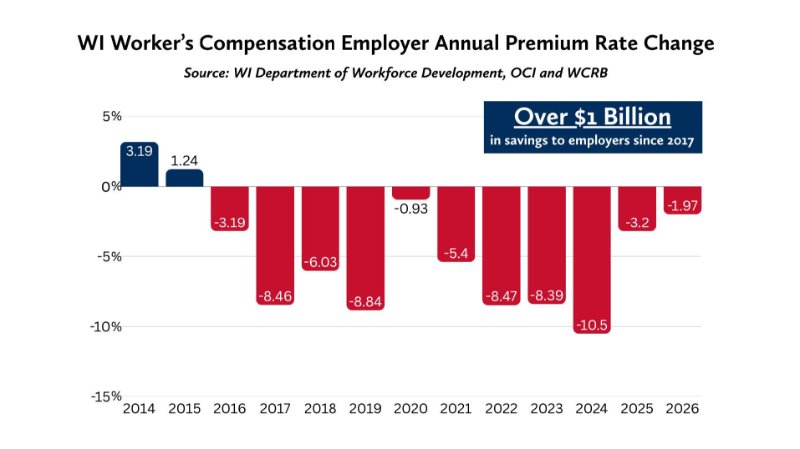
MADISON, Wis. – Wisconsin businesses will once again pay less for worker's compensation insurance for the 11th year in a row. The state's Department of Workforce Development (DWD) and the Office of the Commissioner of Insurance (OCI) announced Thursday that average premium rates dropped 1.97% beginning October 1, 2026, saving employers an estimated $36 million over the coming year. The decrease follows a 10.50% reduction in 2024 and a 3.20% reduction in 2025, and brings the state's cumulative savings for employers to well over the $1 billion milestone first reported in 2024. Wisconsin's rate streak reflects a system that gives injured workers the care they deserve and returns them to work quickly – critical components that help prevent injuries from worsening into total or permanent disabilities.
In their press release announcing yet another premium reduction, Wisconsin Department of Workforce Development Secretary Amy Pechacek said workplaces that are "fair, just and safe" give Wisconsin employers a competitive edge in recruitment and retention, and Wisconsin Insurance Commissioner Nathan Houdek said employers can continue to count on a competitive insurance marketplace for affordable, high-quality coverage.
Four health care advocacy organizations serving as liaisons to the Worker’s Compensation Advisory Committee (WCAC) praised the announcement:
Kyle O’Brien, President and CEO, Wisconsin Hospital Association: "Eleven straight years of lower premiums shows what happens when a system is built to get people the right care quickly and get them back on the job. Injured workers get timely treatment, providers are paid fairly, and businesses keep seeing savings. That's a balance worth protecting."
Mark Grapentine, Chief Policy and Advocacy Officer, Wisconsin Medical Society: "Lower premiums are good news for employers, and they're the product of a system where workers get quick access to effective care. We should keep it that way."
John Murray, Executive Director, Wisconsin Chiropractic Association: "Our members hear from patients who are grateful for the care they receive through worker's compensation. A system that delivers for patients, providers and employers alike is truly a national success story."
Annie Early, Government Affairs Consultant, APTA Wisconsin: "Prompt treatment is what gets injured workers back to work. Eleven years of falling rates tell us the current approach is working."
It’s clear the facts and data point toward a worker’s compensation program that’s the envy of the rest of the nation. Wisconsin should be proud of the continued success of this program, and the health care liaisons warn against any efforts to artificially limit health care payments for treating injured workers by forcing an artificial, non-negotiated fee schedule on health care. The liaisons warn that such a move could lead to fewer health care clinicians participating in the worker’s compensation program, meaning longer wait times and slower return to work for injured patients.
For more information, contact:
Kyle O’Brien, Wisconsin Hospital Association
Mark Grapentine, Wisconsin Medical Society
John Murray, Wisconsin Chiropractic Association
Annie Early, APTA Wisconsin