Quality Advisor
QUALITY EVENTS
Click here to view quality event calendar
QUALITY IMPROVEMENT TEAM
Nadine Allen
Chief Quality OfficerMarcia Egle
Administrative AssistantKelli Evenson
Administrative AssistantStacy Kopp
Clinical Quality Improvement ManagerJenny Pritchett
Clinical Quality Improvement ManagerCasey Zimpel
Clinical Quality Improvement ManagerJill Lindwall
Quality DirectorSubscribe to The Quality Advisor
News from the CQO's Desk
 National Rural Health Day is November 19!
Wisconsin's rural hospitals and health systems are critical to the health and vitality of the communities they serve. On National Rural Health Day, we recognize the dedicated professionals who work every day to provide high-quality care, respond to emergencies, support families and improve health outcomes close to home. Their commitment helps ensure that rural communities across Wisconsin remain strong, healthy and vibrant.
 2027 WHA Excellence in Quality and Patient Safety Award
Shine a Light on Your Team’s Commitment to Quality and Safety
This annual recognition highlights the innovative and impactful work being done across Wisconsin to improve quality, enhance patient safety and advance health care delivery. All WHA member hospitals and health systems are eligible to apply.
Award Categories
- General Medical/Surgical Hospitals: Under 25 beds
- General Medical/Surgical Hospitals: 25-99 beds
- General Medical/Surgical Hospitals: 100+ beds
- NEW Expanded Category: Health Systems, Specialty and Coordinated Care - recognizing quality and patient safety initiatives led by health systems, specialty hospitals and organizations delivering coordinated care across multiple settings and provider types.
Applications for the 2027 awards are open and will be accepted through December 15, 2026. To learn more about the award criteria and categories, visit the 2027 Excellence in Quality and Patient Safety Awards webpage or submit an application form.
We encourage organizations of all sizes to share their improvement stories and successful practices through the awards program. In addition, applicants and all quality improvement teams are encouraged to showcase their work at the Health Care Quality Showcase held in conjunction with Advocacy Day on April 21, 2027. The poster showcase offers an opportunity to share lessons learned, celebrate successes and inspire improvement efforts across Wisconsin.
 Quality Administrative Assistant Marcia to Retire After Nine Years of Service
At the end of November, Marcia will retire from WHA after nine years of service as the Quality team's administrative assistant. Throughout her time with WHA, she has been an integral part of the team's work and a familiar resource for hospital quality leaders across Wisconsin.
Many quality leaders have worked with Marcia through educational programs, committee meetings, webinars, quality improvement initiatives and countless emails and phone calls. She supports the Quality Measures Team, produces the Quality Advisor newsletter, coordinates the annual Quality Poster Showcase, and helps manage the many details behind the Quality & Patient Safety Awards program and recognition dinner. Her work helps ensure these programs and events run smoothly and successfully year after year.
Marcia's impact extends far beyond any one project or event. She is often the person behind the scenes coordinating logistics, answering questions, supporting communications, scheduling meetings and helping the team stay organized. Her attention to detail, positive attitude and willingness to help have benefited not only the Quality team, but also quality leaders and hospital teams across Wisconsin.
As Marcia prepares for retirement on November 30, we want to thank her for her dedication, partnership and many contributions to advancing quality improvement efforts across the state. We wish her all the best in this exciting next chapter and are grateful for the lasting impact she has made on WHA and Wisconsin health care.
CY 2027 OPPS Final Rule Includes Important Changes for OQR and Hospital Star Ratings
The Centers for Medicare & Medicaid Services (CMS) recently finalized the CY 2027 Hospital Outpatient Prospective Payment System (OPPS) Final Rule, which includes several updates that quality leaders should understand. Under the Hospital Outpatient Quality Reporting (OQR) Program, hospitals must successfully report required quality data to receive their full annual OPPS payment update. Hospitals that fail to meet OQR requirements are subject to a two-percentage-point reduction in their annual payment update, making OQR a pay-for-reporting program with direct financial implications for hospital outpatient reimbursement.
The rule also finalizes changes to CMS's Overall Hospital Quality Star Ratings methodology, with increased weight assigned to the Safety of Care measure group. CMS's intent is to place greater emphasis on patient safety performance when calculating Star Ratings, meaning measures related to healthcare-associated infections and other patient safety outcomes will have a larger influence on hospitals' overall ratings than under the previous methodology. As Star Ratings remain a highly visible public reporting tool, these changes may affect hospital quality improvement priorities and performance monitoring efforts.
Additional quality-related updates include revisions to OQR data validation processes, including validation of electronic clinical quality measures (eCQMs), underscoring the need for accurate and reliable quality data submission. CMS also finalized the removal of the Appropriate Follow-Up Interval for Normal Colonoscopy in Average Risk Patients measure from the OQR Program as part of its ongoing efforts to reduce reporting burden and retire measures that provide limited value.
DataGen will host a national webinar for hospitals on the CY 2027 OPPS Final Rule and Analysis on Tuesday, December 1. Register here and review CY 2027 Medicare Outpatient PPS Final Rule Brief here.
For additional details on the broader CY 2027 OPPS Final Rule, including site-neutral payment policies and 340B drug payment changes, see the recent Valued Voice article, CMS Issues Final 2027 Outpatient Rule with Site-Neutral and 340B Cuts. The article also includes links to CMS resources and the full final rule.
NHSN 2022 HAI Rebaseline Implemented in CheckPoint
We would like to share an important update regarding healthcare-associated infection (HAI) measures reported through NHSN and displayed in CheckPoint.
At the September 18 Quality Measures Team meeting, members agreed to adopt the NHSN 2022 HAI rebaseline in CheckPoint, replacing the previous 2015 baseline. This update has now been implemented, and all November infection reporting in CheckPoint will reflect the 2022 baseline methodology.
What is changing?
The Centers for Disease Control and Prevention (CDC), through the National Healthcare Safety Network (NHSN), periodically updates the national baseline used to calculate Standardized Infection Ratios (SIRs) and Standardized Utilization Ratios (SURs). The new 2022 rebaseline incorporates more current national health care data and updated risk-adjustment models, reflecting changes in patient populations, care delivery and infection prevention practices since the previous 2015 baseline.
Important consideration
Because the 2015 and 2022 baselines use different national reference populations and risk-adjustment methodologies, results calculated using the 2022 baseline should not be directly compared to results calculated using the 2015 baseline. Apparent changes in performance may reflect the new NHSN methodology rather than a change in infection prevention outcomes.
This update also aligns CheckPoint with current NHSN and CMS methodologies. CMS public reporting programs now rely on the NHSN 2022 baseline for healthcare-associated infection measures, ensuring hospitals are comparing their performance using the same national benchmarks reflected in public reporting.
The transition is now complete, and all infection measures reported in CheckPoint beginning with November 2026 reporting will reflect the NHSN 2022 rebaseline.
 Wisconsin Quality Residency Program Holds Interactive Session on Performance Improvement and Change Management
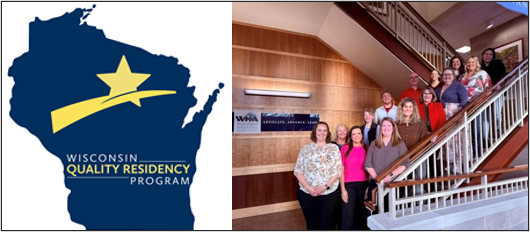
The Wisconsin Quality Residency Program, a partnership between the Wisconsin Hospital Association (WHA) and Rural Wisconsin Health Cooperative (RWHC), with support from the Wisconsin Office of Rural Health, held an interactive, in-person session on performance improvement and change management on Nov. 11 at the WHA offices in Fitchburg.
Residents explored practical approaches to leading improvement initiatives, managing organizational change and building engagement to move projects from planning to implementation. Through discussion and real-world examples, participants examined strategies for sustaining improvement efforts and navigating change within complex health care organizations.
Hospitals participating in the 2026-2027 Wisconsin Quality Residency Program include:
- Southwest Health
- Tamarack Health Ashland Medical Center
- Vernon Health
- Aspirus Stevens Point Hospital
- Aspirus Wisconsin Rapids Hospital
- Reedsburg Area Medical Center
- Tomah Health
- Stoughton Health
- Hospital Sisters Health System-Oconto Falls
- UW Health
For more information about the Wisconsin Quality Residency Program, visit the Wisconsin Quality Residency Program.
Session faculty included Larry Dux, former director of clinical informatics community hospital site support at Froedtert & the Medical College of Wisconsin and Brenda Fairfull, senior organizational development business partner, change management, at Froedtert ThedaCare.
Fall 2026 Leapfrog Safety Scores Released
The Fall 2026 Hospital Safety Grades are out. If you need assistance with talking points, please reach out to Nadine Allen.
News from the CQO's Desk
National Rural Health Day is November 19!
Wisconsin's rural hospitals and health systems are critical to the health and vitality of the communities they serve. On National Rural Health Day, we recognize the dedicated professionals who work every day to provide high-quality care, respond to emergencies, support families and improve health outcomes close to home. Their commitment helps ensure that rural communities across Wisconsin remain strong, healthy and vibrant.
2027 WHA Excellence in Quality and Patient Safety Award
Shine a Light on Your Team’s Commitment to Quality and Safety
This annual recognition highlights the innovative and impactful work being done across Wisconsin to improve quality, enhance patient safety and advance health care delivery. All WHA member hospitals and health systems are eligible to apply.
Award Categories
- General Medical/Surgical Hospitals: Under 25 beds
- General Medical/Surgical Hospitals: 25-99 beds
- General Medical/Surgical Hospitals: 100+ beds
- NEW Expanded Category: Health Systems, Specialty and Coordinated Care - recognizing quality and patient safety initiatives led by health systems, specialty hospitals and organizations delivering coordinated care across multiple settings and provider types.
Applications for the 2027 awards are open and will be accepted through December 15, 2026. To learn more about the award criteria and categories, visit the 2027 Excellence in Quality and Patient Safety Awards webpage or submit an application form.
We encourage organizations of all sizes to share their improvement stories and successful practices through the awards program. In addition, applicants and all quality improvement teams are encouraged to showcase their work at the Health Care Quality Showcase held in conjunction with Advocacy Day on April 21, 2027. The poster showcase offers an opportunity to share lessons learned, celebrate successes and inspire improvement efforts across Wisconsin.
Quality Administrative Assistant Marcia to Retire After Nine Years of Service
At the end of November, Marcia will retire from WHA after nine years of service as the Quality team's administrative assistant. Throughout her time with WHA, she has been an integral part of the team's work and a familiar resource for hospital quality leaders across Wisconsin.
Many quality leaders have worked with Marcia through educational programs, committee meetings, webinars, quality improvement initiatives and countless emails and phone calls. She supports the Quality Measures Team, produces the Quality Advisor newsletter, coordinates the annual Quality Poster Showcase, and helps manage the many details behind the Quality & Patient Safety Awards program and recognition dinner. Her work helps ensure these programs and events run smoothly and successfully year after year.
Marcia's impact extends far beyond any one project or event. She is often the person behind the scenes coordinating logistics, answering questions, supporting communications, scheduling meetings and helping the team stay organized. Her attention to detail, positive attitude and willingness to help have benefited not only the Quality team, but also quality leaders and hospital teams across Wisconsin.
As Marcia prepares for retirement on November 30, we want to thank her for her dedication, partnership and many contributions to advancing quality improvement efforts across the state. We wish her all the best in this exciting next chapter and are grateful for the lasting impact she has made on WHA and Wisconsin health care.
CY 2027 OPPS Final Rule Includes Important Changes for OQR and Hospital Star Ratings
The Centers for Medicare & Medicaid Services (CMS) recently finalized the CY 2027 Hospital Outpatient Prospective Payment System (OPPS) Final Rule, which includes several updates that quality leaders should understand. Under the Hospital Outpatient Quality Reporting (OQR) Program, hospitals must successfully report required quality data to receive their full annual OPPS payment update. Hospitals that fail to meet OQR requirements are subject to a two-percentage-point reduction in their annual payment update, making OQR a pay-for-reporting program with direct financial implications for hospital outpatient reimbursement.
The rule also finalizes changes to CMS's Overall Hospital Quality Star Ratings methodology, with increased weight assigned to the Safety of Care measure group. CMS's intent is to place greater emphasis on patient safety performance when calculating Star Ratings, meaning measures related to healthcare-associated infections and other patient safety outcomes will have a larger influence on hospitals' overall ratings than under the previous methodology. As Star Ratings remain a highly visible public reporting tool, these changes may affect hospital quality improvement priorities and performance monitoring efforts.
Additional quality-related updates include revisions to OQR data validation processes, including validation of electronic clinical quality measures (eCQMs), underscoring the need for accurate and reliable quality data submission. CMS also finalized the removal of the Appropriate Follow-Up Interval for Normal Colonoscopy in Average Risk Patients measure from the OQR Program as part of its ongoing efforts to reduce reporting burden and retire measures that provide limited value.
DataGen will host a national webinar for hospitals on the CY 2027 OPPS Final Rule and Analysis on Tuesday, December 1. Register here and review CY 2027 Medicare Outpatient PPS Final Rule Brief here.
For additional details on the broader CY 2027 OPPS Final Rule, including site-neutral payment policies and 340B drug payment changes, see the recent Valued Voice article, CMS Issues Final 2027 Outpatient Rule with Site-Neutral and 340B Cuts. The article also includes links to CMS resources and the full final rule.
NHSN 2022 HAI Rebaseline Implemented in CheckPoint
We would like to share an important update regarding healthcare-associated infection (HAI) measures reported through NHSN and displayed in CheckPoint.
At the September 18 Quality Measures Team meeting, members agreed to adopt the NHSN 2022 HAI rebaseline in CheckPoint, replacing the previous 2015 baseline. This update has now been implemented, and all November infection reporting in CheckPoint will reflect the 2022 baseline methodology.
What is changing?
The Centers for Disease Control and Prevention (CDC), through the National Healthcare Safety Network (NHSN), periodically updates the national baseline used to calculate Standardized Infection Ratios (SIRs) and Standardized Utilization Ratios (SURs). The new 2022 rebaseline incorporates more current national health care data and updated risk-adjustment models, reflecting changes in patient populations, care delivery and infection prevention practices since the previous 2015 baseline.
Important consideration
Because the 2015 and 2022 baselines use different national reference populations and risk-adjustment methodologies, results calculated using the 2022 baseline should not be directly compared to results calculated using the 2015 baseline. Apparent changes in performance may reflect the new NHSN methodology rather than a change in infection prevention outcomes.
This update also aligns CheckPoint with current NHSN and CMS methodologies. CMS public reporting programs now rely on the NHSN 2022 baseline for healthcare-associated infection measures, ensuring hospitals are comparing their performance using the same national benchmarks reflected in public reporting.
The transition is now complete, and all infection measures reported in CheckPoint beginning with November 2026 reporting will reflect the NHSN 2022 rebaseline.
Wisconsin Quality Residency Program Holds Interactive Session on Performance Improvement and Change Management
The Wisconsin Quality Residency Program, a partnership between the Wisconsin Hospital Association (WHA) and Rural Wisconsin Health Cooperative (RWHC), with support from the Wisconsin Office of Rural Health, held an interactive, in-person session on performance improvement and change management on Nov. 11 at the WHA offices in Fitchburg.
Residents explored practical approaches to leading improvement initiatives, managing organizational change and building engagement to move projects from planning to implementation. Through discussion and real-world examples, participants examined strategies for sustaining improvement efforts and navigating change within complex health care organizations.
Hospitals participating in the 2026-2027 Wisconsin Quality Residency Program include:
- Southwest Health
- Tamarack Health Ashland Medical Center
- Vernon Health
- Aspirus Stevens Point Hospital
- Aspirus Wisconsin Rapids Hospital
- Reedsburg Area Medical Center
- Tomah Health
- Stoughton Health
- Hospital Sisters Health System-Oconto Falls
- UW Health
For more information about the Wisconsin Quality Residency Program, visit the Wisconsin Quality Residency Program.
Session faculty included Larry Dux, former director of clinical informatics community hospital site support at Froedtert & the Medical College of Wisconsin and Brenda Fairfull, senior organizational development business partner, change management, at Froedtert ThedaCare.
Fall 2026 Leapfrog Safety Scores Released
The Fall 2026 Hospital Safety Grades are out. If you need assistance with talking points, please reach out to Nadine Allen.
QUALITY IMPROVEMENT TEAM
Nadine Allen
Chief Quality OfficerMarcia Egle
Administrative AssistantKelli Evenson
Administrative AssistantStacy Kopp
Clinical Quality Improvement ManagerJenny Pritchett
Clinical Quality Improvement ManagerCasey Zimpel
Clinical Quality Improvement ManagerJill Lindwall
Quality Director