Click here to view past issues
IN THIS ISSUE
- WHA Presents State Capitol Briefing on 2026 Health Care Workforce Report
- Register Today for Part 2 of the WHA WI Health Care Workforce Webinar Series: Relieve Workforce Burden
- Senate Committee on Health Hears How Partnerships Promote Clinical Placement
- Election Season: Disburse Conduit Dollars Now
- WHA 2026 Nominating and Awards Committee Seeking Nominations for Awards, Board Members
EDUCATION EVENTS
Oct. 15, 2026
Substance Use Disorders Management Boot CampOct. 15, 2026
Culture College – Breakthrough Strategies for Creating and Sustaining a Magnetic CultureOct. 20, 2026
WIpop Virtual Training: Session 1Click here to view education event calendar
View more issues of The Valued Voice
Sign Up for WHA's Newsletter


WHA Presents State Capitol Briefing on 2026 Health Care Workforce Report
Hospital leaders join O’Brien and Zenk to highlight challenges and offer solutions
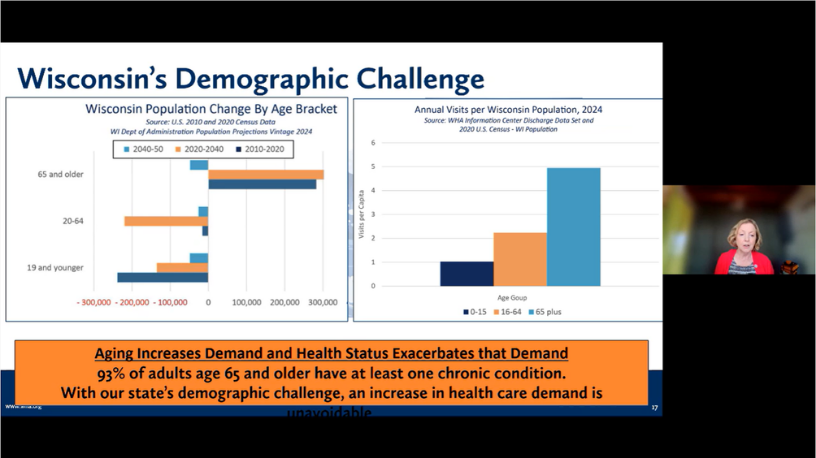
The chairs and ranking members of the Wisconsin Legislature’s Senate Committee on Health and the Assembly Committee on Health, Aging and Long-Term Care hosted a Wisconsin Hospital Association (WHA) workforce legislative briefing for state policymakers and staff August 27, 2026. The virtual briefing was attended by nearly 120 legislators, staff, and candidates for state legislative office, along with WHA members.
WHA’s Kyle O’Brien, President and CEO, and Ann Zenk, senior vice president workforce and clinical practice, shared findings and recommendations from the WHA 2026 Wisconsin Health Care Workforce Report. Chelsea Hardacre, President, SSM Health Monroe and SSM Health St. Mary’s - Janesville, and Dr. Michael J. Dolan, Chief Clinical Officer, Emplify Health – Gundersen Region, joined O’Brien and Zenk and provided real-world examples of the challenges they face, how WHA members are growing, supporting and sustaining their own workforce, and how the tools and resources provided by the state legislature have assisted in those efforts.
State Sens. Rachael Cabral-Guevara and Jeff Smith and State Reps. Clint Moses and Lisa Subeck invited state legislators and legislative staff to join them to discuss the issues facing health care and the health care workforce. More importantly, legislators and their staff heard about solutions and how sound health care policy strengthens the health care workforce and assists policymakers in addressing current and future health care needs.
Cabral-Guevara opened the briefing noting that WHA has “always been upfront and very quick to let us know what the issues are” and she looks forward to the report which always includes hard data and statistics to help inform legislators.
O’Brien provided an overview of the environment and challenges confronting Wisconsin hospitals and health systems and their workforce. He noted that WHA’s workforce report has become a sought after and relied-upon guide for policymakers and industry stakeholders and a catalyst for public policy changes that support health care and the health care workforce. O’Brien recognized the value of the Legislature’s much-appreciated partnership in key workforce policy that helps improve health care in Wisconsin: “Our partnership with you matters.”
O’Brien highlighted for legislators and their staff some of the funding challenges hospitals face, largely due to demographic changes. “With our aging population, hospitals are seeing more and more patients covered by Medicare, which like Medicaid, underpays hospitals for their costs. At the same time, inflationary costs that hospitals experience far exceed the growth in hospital prices and the reimbursement hospitals receive to cover costs.”
Zenk also thanked the Legislature for their expertise, their partnership and their support, and explained how demographics and the “Silver Tsunami,” as the aging of the very large baby boom generation has been termed, are simultaneously increasing health care demand and shrinking the available workforce.
Zenk noted “Demographics are largely beyond our control, but we can partner on the things within our control. We can help grow the workforce faster, and we can help the workforce we have work to their full potential, relieved of regulatory burden wherever possible.”
Zenk reviewed key data from the report, and highlighted key accomplishments made together, such as the growth of Wisconsin’s physician workforce through the WHA-crafted DHS “Grow Our Own” grant program, enabled by Wisconsin’s high quality of care, which attracts high-quality health care professionals, and by Wisconsin’s balanced liability environment. Zenk then turned it over to a Wisconsin native who exemplifies WHA’s “Grow Our Own” equation.
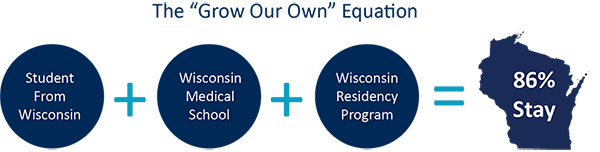
Dr. Michael Dolan discussed how he and his daughter (and work supervisor) are both proud graduates of Wisconsin medical programs and didn’t initially anticipate staying in Wisconsin for their careers. However, after completing residency training here, they have been here ever since.
Dr. Dolan relayed statistics from residency programs at Emplify Health showing that medical students who are placed in a Wisconsin residency often end up staying in Wisconsin to work after graduation.
“I believe that medical education and graduate medical education is the lifeblood making sure that the supply of physicians in these core specialties can be maintained for generations, and in Wisconsin, we are a great example of how that works,” said Dolan.
Zenk followed with an update on the very successful “Grow Our Own” grant program, and thanked the state’s legislators for all they have done to fund the program and keep it up-to-date, noting “The GME, Allied Health and Advanced Practice Clinician grants have resulted in a $100 million public-private investment in our health care workforce.” Zenk added, “The responsiveness of our state policymakers, by rapidly adding registered nurses to this grant program to help address the current nursing shortage is the perfect example of why our partnership is so valuable; we’re addressing the right issues in a timely fashion, together.”
Hardacre, in her current role as a hospital president, and her prior role as a regional nurse executive, showed legislators how this “grow from within investment” is being utilized at her hospitals to train, recruit, retain and support registered nurses. Hardacre emphasized SSM Health Monroe’s partnership with Blackhawk Technical College to reopen a nursing program that had been shut down for 25 years due to lack of clinical instructors. SSM Health Monroe now provides clinical instructors for the program, in addition to creating opportunities for students to work at SSM and take advantage of excellent employer benefits to assist with the cost of school.
WHA’s Ann Zenk closed out the briefing by noting, “Expanding educational capacity and creating more training opportunities is important, and we are making good progress together, but with the demographic challenges ahead, it’s unlikely that even with the best efforts our health care workforce can grow fast enough.” Zenk added, “We also need your help to make sure health care professionals can work to the full scope of their education, training and experience, and not be burdened by unnecessary regulation or payer demands.”
You can find more information about Wisconsin’s health care workforce and WHA’s recommendations on WHA's Workforce Report webpage. Reach out to WHA’s Ann Zenk with questions or ideas regarding the health care workforce or WHA’s 2026 Wisconsin Health Care Workforce Report.
WHA Presents State Capitol Briefing on 2026 Health Care Workforce Report
Hospital leaders join O’Brien and Zenk to highlight challenges and offer solutions
The chairs and ranking members of the Wisconsin Legislature’s Senate Committee on Health and the Assembly Committee on Health, Aging and Long-Term Care hosted a Wisconsin Hospital Association (WHA) workforce legislative briefing for state policymakers and staff August 27, 2026. The virtual briefing was attended by nearly 120 legislators, staff, and candidates for state legislative office, along with WHA members.
WHA’s Kyle O’Brien, President and CEO, and Ann Zenk, senior vice president workforce and clinical practice, shared findings and recommendations from the WHA 2026 Wisconsin Health Care Workforce Report. Chelsea Hardacre, President, SSM Health Monroe and SSM Health St. Mary’s - Janesville, and Dr. Michael J. Dolan, Chief Clinical Officer, Emplify Health – Gundersen Region, joined O’Brien and Zenk and provided real-world examples of the challenges they face, how WHA members are growing, supporting and sustaining their own workforce, and how the tools and resources provided by the state legislature have assisted in those efforts.
State Sens. Rachael Cabral-Guevara and Jeff Smith and State Reps. Clint Moses and Lisa Subeck invited state legislators and legislative staff to join them to discuss the issues facing health care and the health care workforce. More importantly, legislators and their staff heard about solutions and how sound health care policy strengthens the health care workforce and assists policymakers in addressing current and future health care needs.
Cabral-Guevara opened the briefing noting that WHA has “always been upfront and very quick to let us know what the issues are” and she looks forward to the report which always includes hard data and statistics to help inform legislators.
O’Brien provided an overview of the environment and challenges confronting Wisconsin hospitals and health systems and their workforce. He noted that WHA’s workforce report has become a sought after and relied-upon guide for policymakers and industry stakeholders and a catalyst for public policy changes that support health care and the health care workforce. O’Brien recognized the value of the Legislature’s much-appreciated partnership in key workforce policy that helps improve health care in Wisconsin: “Our partnership with you matters.”
O’Brien highlighted for legislators and their staff some of the funding challenges hospitals face, largely due to demographic changes. “With our aging population, hospitals are seeing more and more patients covered by Medicare, which like Medicaid, underpays hospitals for their costs. At the same time, inflationary costs that hospitals experience far exceed the growth in hospital prices and the reimbursement hospitals receive to cover costs.”
Zenk also thanked the Legislature for their expertise, their partnership and their support, and explained how demographics and the “Silver Tsunami,” as the aging of the very large baby boom generation has been termed, are simultaneously increasing health care demand and shrinking the available workforce.
Zenk noted “Demographics are largely beyond our control, but we can partner on the things within our control. We can help grow the workforce faster, and we can help the workforce we have work to their full potential, relieved of regulatory burden wherever possible.”
Zenk reviewed key data from the report, and highlighted key accomplishments made together, such as the growth of Wisconsin’s physician workforce through the WHA-crafted DHS “Grow Our Own” grant program, enabled by Wisconsin’s high quality of care, which attracts high-quality health care professionals, and by Wisconsin’s balanced liability environment. Zenk then turned it over to a Wisconsin native who exemplifies WHA’s “Grow Our Own” equation.
Dr. Michael Dolan discussed how he and his daughter (and work supervisor) are both proud graduates of Wisconsin medical programs and didn’t initially anticipate staying in Wisconsin for their careers. However, after completing residency training here, they have been here ever since.
Dr. Dolan relayed statistics from residency programs at Emplify Health showing that medical students who are placed in a Wisconsin residency often end up staying in Wisconsin to work after graduation.
“I believe that medical education and graduate medical education is the lifeblood making sure that the supply of physicians in these core specialties can be maintained for generations, and in Wisconsin, we are a great example of how that works,” said Dolan.
Zenk followed with an update on the very successful “Grow Our Own” grant program, and thanked the state’s legislators for all they have done to fund the program and keep it up-to-date, noting “The GME, Allied Health and Advanced Practice Clinician grants have resulted in a $100 million public-private investment in our health care workforce.” Zenk added, “The responsiveness of our state policymakers, by rapidly adding registered nurses to this grant program to help address the current nursing shortage is the perfect example of why our partnership is so valuable; we’re addressing the right issues in a timely fashion, together.”
Hardacre, in her current role as a hospital president, and her prior role as a regional nurse executive, showed legislators how this “grow from within investment” is being utilized at her hospitals to train, recruit, retain and support registered nurses. Hardacre emphasized SSM Health Monroe’s partnership with Blackhawk Technical College to reopen a nursing program that had been shut down for 25 years due to lack of clinical instructors. SSM Health Monroe now provides clinical instructors for the program, in addition to creating opportunities for students to work at SSM and take advantage of excellent employer benefits to assist with the cost of school.
WHA’s Ann Zenk closed out the briefing by noting, “Expanding educational capacity and creating more training opportunities is important, and we are making good progress together, but with the demographic challenges ahead, it’s unlikely that even with the best efforts our health care workforce can grow fast enough.” Zenk added, “We also need your help to make sure health care professionals can work to the full scope of their education, training and experience, and not be burdened by unnecessary regulation or payer demands.”
You can find more information about Wisconsin’s health care workforce and WHA’s recommendations on WHA's Workforce Report webpage. Reach out to WHA’s Ann Zenk with questions or ideas regarding the health care workforce or WHA’s 2026 Wisconsin Health Care Workforce Report.
IN THIS ISSUE
- WHA Presents State Capitol Briefing on 2026 Health Care Workforce Report
- Register Today for Part 2 of the WHA WI Health Care Workforce Webinar Series: Relieve Workforce Burden
- Senate Committee on Health Hears How Partnerships Promote Clinical Placement
- Election Season: Disburse Conduit Dollars Now
- WHA 2026 Nominating and Awards Committee Seeking Nominations for Awards, Board Members
EDUCATION EVENTS
Oct. 15, 2026
Substance Use Disorders Management Boot CampOct. 15, 2026
Culture College – Breakthrough Strategies for Creating and Sustaining a Magnetic CultureOct. 20, 2026
WIpop Virtual Training: Session 1