
Click here to view past issues
IN THIS ISSUE
- Legislative Committee Weighing Risks and Benefits of AI in Health Care
- Caring for Wisconsin's Caregivers: WHA Workforce Well-Being Summit
- Reminder: WHA Accepting Applications for Vice President, Workforce & Clinical Practice
- Wisconsin Hospitals State PAC & Conduit Surpasses $300,000
- In Memoriam: Leland "Lee" Olkowski
- Register for the Last 2026 RHeSUS Lunch & Learn on Substance Use Trends and Rural Health
EDUCATION EVENTS
Oct. 15, 2026
Substance Use Disorders Management Boot CampOct. 15, 2026
Culture College – Breakthrough Strategies for Creating and Sustaining a Magnetic CultureOct. 20, 2026
WIpop Virtual Training: Session 1Click here to view education event calendar
View more issues of The Valued Voice
Sign Up for WHA's Newsletter


Legislative Committee Weighing Risks and Benefits of AI in Health Care
Recommendations for legislation anticipated by year end
Last week the Legislative Council Study Committee on the Use of Artificial Intelligence (AI) in Health Care held two days of meetings, hearing from over two dozen health care groups with different perspectives on the need to regulate health care AI. The testimony highlighted AI’s potential to improve care and reduce administrative burden, alongside unresolved questions about privacy, accountability, transparency and autonomous decision making.
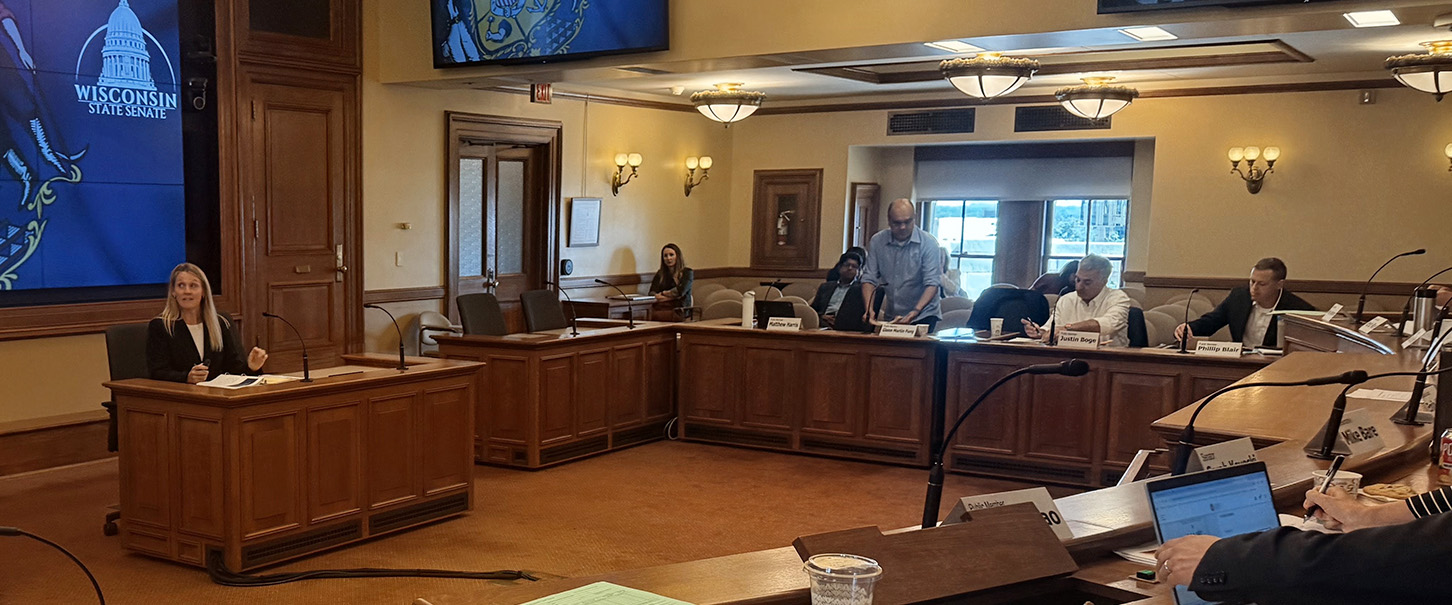 Marshfield Clinic’s Sara Scheu speaking at the Legislative Council Study Committee on the Use of Artificial Intelligence (AI) in Health Care meeting on Sept. 9.
The committee is led by Senator Rachael Cabral-Guevara and is made up of four bipartisan state legislators and 12 expert public members including four leaders from Wisconsin health systems. The group is expected to make recommendations for legislation, with its last meeting scheduled for December.
Speakers ranged from national interest groups, state regulators, payers and providers. Highlights included Sara Scheu, Transformation Business Partner for Marshfield Clinic, who presented an overview of Marshfield’s AI foundation. Marshfield’s foundation includes an emphasis on human judgment, safety and monitors, and transparency and trust. Answering questions from interested committee members, Scheu stressed that if the committee determines regulations are needed, they should be future-proof and aligned with existing requirements at the federal level and in other states. This aligns with WHA’s previous written comments to the committee covered in The Valued Voice.
The committee also began considering whether Wisconsin should create an AI regulatory sandbox[KH1.1] similar to what is being tested in other states, most notably Utah. Utah’s Director of the Office of Artificial Intelligence Policy, Zachary Boyd, testified to the committee and described the state’s regulatory sandbox as a practical way to protect the public while encouraging innovation and helping regulators learn from real-world AI deployments.
Under Utah’s program, organizations may apply for approval to test AI applications for a limited period of time that would otherwise be prohibited under state law. Boyd stated that they have received interest in pilots involving mental health, dentistry, medication titration and protocol-based treatments. One application already approved in Utah allows AI company Doctronic to test automated prescription renewals.
Wisconsin’s Legislative Council Study Committee is scheduled to meet three more times before the end of the year and will make recommendations to the Legislature. WHA will continue engaging with the study committee as it evaluates potential policy recommendations affecting hospitals, health systems, clinicians and patients.
For more information, contact WHA Policy Counsel Andrew Hanus.
Legislative Committee Weighing Risks and Benefits of AI in Health Care
Recommendations for legislation anticipated by year end
Last week the Legislative Council Study Committee on the Use of Artificial Intelligence (AI) in Health Care held two days of meetings, hearing from over two dozen health care groups with different perspectives on the need to regulate health care AI. The testimony highlighted AI’s potential to improve care and reduce administrative burden, alongside unresolved questions about privacy, accountability, transparency and autonomous decision making.
Marshfield Clinic’s Sara Scheu speaking at the Legislative Council Study Committee on the Use of Artificial Intelligence (AI) in Health Care meeting on Sept. 9.
The committee is led by Senator Rachael Cabral-Guevara and is made up of four bipartisan state legislators and 12 expert public members including four leaders from Wisconsin health systems. The group is expected to make recommendations for legislation, with its last meeting scheduled for December.
Speakers ranged from national interest groups, state regulators, payers and providers. Highlights included Sara Scheu, Transformation Business Partner for Marshfield Clinic, who presented an overview of Marshfield’s AI foundation. Marshfield’s foundation includes an emphasis on human judgment, safety and monitors, and transparency and trust. Answering questions from interested committee members, Scheu stressed that if the committee determines regulations are needed, they should be future-proof and aligned with existing requirements at the federal level and in other states. This aligns with WHA’s previous written comments to the committee covered in The Valued Voice.
The committee also began considering whether Wisconsin should create an AI regulatory sandbox[KH1.1] similar to what is being tested in other states, most notably Utah. Utah’s Director of the Office of Artificial Intelligence Policy, Zachary Boyd, testified to the committee and described the state’s regulatory sandbox as a practical way to protect the public while encouraging innovation and helping regulators learn from real-world AI deployments.
Under Utah’s program, organizations may apply for approval to test AI applications for a limited period of time that would otherwise be prohibited under state law. Boyd stated that they have received interest in pilots involving mental health, dentistry, medication titration and protocol-based treatments. One application already approved in Utah allows AI company Doctronic to test automated prescription renewals.
Wisconsin’s Legislative Council Study Committee is scheduled to meet three more times before the end of the year and will make recommendations to the Legislature. WHA will continue engaging with the study committee as it evaluates potential policy recommendations affecting hospitals, health systems, clinicians and patients.
For more information, contact WHA Policy Counsel Andrew Hanus.
IN THIS ISSUE
- Legislative Committee Weighing Risks and Benefits of AI in Health Care
- Caring for Wisconsin's Caregivers: WHA Workforce Well-Being Summit
- Reminder: WHA Accepting Applications for Vice President, Workforce & Clinical Practice
- Wisconsin Hospitals State PAC & Conduit Surpasses $300,000
- In Memoriam: Leland "Lee" Olkowski
- Register for the Last 2026 RHeSUS Lunch & Learn on Substance Use Trends and Rural Health
EDUCATION EVENTS
Oct. 15, 2026
Substance Use Disorders Management Boot CampOct. 15, 2026
Culture College – Breakthrough Strategies for Creating and Sustaining a Magnetic CultureOct. 20, 2026
WIpop Virtual Training: Session 1