
Aurora Health Care, 2025 Community Benefits
Aurora Health Care’s mobile health teams offer hope, healing in disaster aftermath
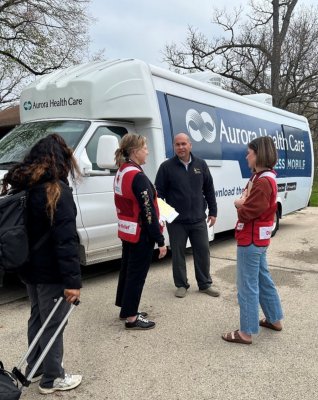
An estimated 100 residents of an 85-unit apartment complex lost everything, including essential medications some were forced to leave behind when escaping from the blaze that claimed five lives. Milwaukee County administrators asked Aurora’s mobile health team to join the emergency aid collaboration, based on the team’s recognized expertise in delivering care for all. Although the community where the fire happened was outside of the area the mobile health unit typically serves, the Aurora team responded.
“Our community partners know our teammates and program to be dedicated to meeting the unique needs of the Milwaukee community with humanity, dedication, and flexibility,” said Sarah Katsandonis, mobile care outreach specialist for Aurora Health Care. “The core of our work is serving individuals who are not engaging with traditional health care due to misinformation, lack of trust, inability to navigate complex health care systems, and other barriers like cost.”
The American Red Cross secured emergency shelter for 40 survivors of the fire. And when the mobile health team arrived, our teammates discovered that nine fire survivors had chronic conditions, such as hypertension, diabetes, asthma and mental health disorders. Together, the nine residents needed a total of 20 prescription medications. Collaboration, innovative thinking to the rescue Without their medications, these survivors were in danger of disease progression. Yet, they had no identification, insurance cards or credit cards in their possession, and no way to travel the miles between the shelter and their neighborhood pharmacy.
“We set out with an open mind as always — expecting to offer our normal services and meet whatever needs exist. We knew that prescription replacement would be a big need,” Sarah explained.
To tackle the urgent need for replacement medications, the mobile health team collaborated with Aurora Sinai Medical Center’s outpatient pharmacy. Despite complexities with insurance and costs, the pharmacy quickly refilled the 20 prescriptions prescribed by the mobile health team. The Red Cross paid for the emergency prescriptions and distributed them, ensuring essential care with dignity.
Next the mobile health team addressed a variety of medical and emotional issues caused by the fire. The team provided services for opioid addiction recovery, asthma, depression, PTSD, high blood pressure, diabetes and injuries from the fire. In addition to administering medical care, mobile health teammates listened compassionately and connected residents to important resources like the Aging and Disability Resource Center and Aurora Healing & Advocacy Services.
Access to Specialty Care for the Uninsured – A Coordinated Approach
Securing access to specialty care for low-income, uninsured individuals is a complex and intractable issue. There are many barriers to receiving specialty care in a timely and coordinated manner, even for those with an established medical home and health insurance coverage. With approximately 7% of Milwaukee County residents uninsured at any point in time, Milwaukee’s health systems have sponsored free clinics and worked closely with FQHCs and other community clinics to weave a stronger safety net of care for low-income and vulnerable individuals. While these safety net clinics can provide primary care to uninsured patients, access to specialty care remained a challenge.
Through the Milwaukee Health Care Partnership, the four Milwaukee health systems – Aurora Health Care, Ascension Wisconsin, Children’s Wisconsin, and Froedtert ThedaCare Health - established the Specialty Access for Uninsured Program (SAUP) to create a barrier-free, coordinated process to provide specialty testing and treatment for uninsured patients.
SAUP improves the efficiency and effectiveness of care between health partners and offers timely, managed, and clinically appropriate access to specialty care for uninsured patients who are established in a primary care medical home at one of Milwaukee’s eleven participating safety-net clinics. The result? In 2024 alone, the three adult health systems have guided more than 1,000 referrals for specialty services – from cancer treatment to vascular surgery!
Sarah (Name changed for patient privacy) is one of these patients. Sarah does not have insurance and has been a long-time patient at Aurora Walker’s Point Community Clinic (Walker’s Point). In recent months, she experienced ongoing abdominal pain and communicated this with her doctor at a routine visit. After obtaining various labs and ultrasounds at Walker’s Point, the provider determined specialty care was needed. A SAUP referral was placed for her to see a specialist at Aurora St. Luke’s Medical Center (Aurora).
This patient saw the gynecologist who performed an exam and biopsy. Sarah received a diagnosis of metastatic cervical adenocarcinoma, gastric type. A PET scan showed uptake of the cancer at the head of the pancreas. Sarah is now actively receiving cancer care with Aurora.
Sarah described her journey from diagnosis to treatment as smooth and is eager to share her gratitude. She particularly praised her providers, noting, “I am thankful to my PCP at Walker’s Point for connecting me to the care I need, and the team at St. Luke’s has been terrific. My oncologist is a great provider, and I’m receiving excellent care.”