
Click here to view past issues
IN THIS ISSUE
- WI Act 115 “Next-of-Kin” Law Takes Effect
- WHA Health Care Leadership Academy Graduate Spotlight: Hannah Young
- Caring for Wisconsin’s Caregivers Steering Committee Advances Year One Success and Prepares for Action
- Johns Receives First Eric Borgerding Health Care Advocacy Scholarship
- Register Today for a Complimentary Webinar on the Impacts to Wisconsin Hospitals on Rising Claims; Strategies for Leaders
- Nominations Open for 2026 Global Vision Community Partnership Award
- Fast Facts from the WHA Information Center: Lyme Disease
EDUCATION EVENTS
Oct. 15, 2026
Substance Use Disorders Management Boot CampOct. 15, 2026
Culture College – Breakthrough Strategies for Creating and Sustaining a Magnetic CultureOct. 20, 2026
WIpop Virtual Training: Session 1Click here to view education event calendar
View more issues of The Valued Voice
Sign Up for WHA's Newsletter


Fast Facts from the WHA Information Center: Lyme Disease
 With summer just around the corner, Wisconsinites will be spending more time outdoors enjoying all the season has to offer. While summer is a favorite time of year for many, it's also important to be aware of certain seasonal health risks. Lyme disease is one such concern, affecting both people and pets.
According to The Centers for Disease Control and Prevention (CDC), over 89,000 cases of Lyme disease were reported in 2023, but it’s estimated the number of cases is closer to 476,000. Lyme disease, caused by the borrelia bacteria from ticks, can be found throughout most of the United States. It’s most common in the upper Midwest and the northeastern and mid-Atlantic states in grassy, wooded or brushy areas.
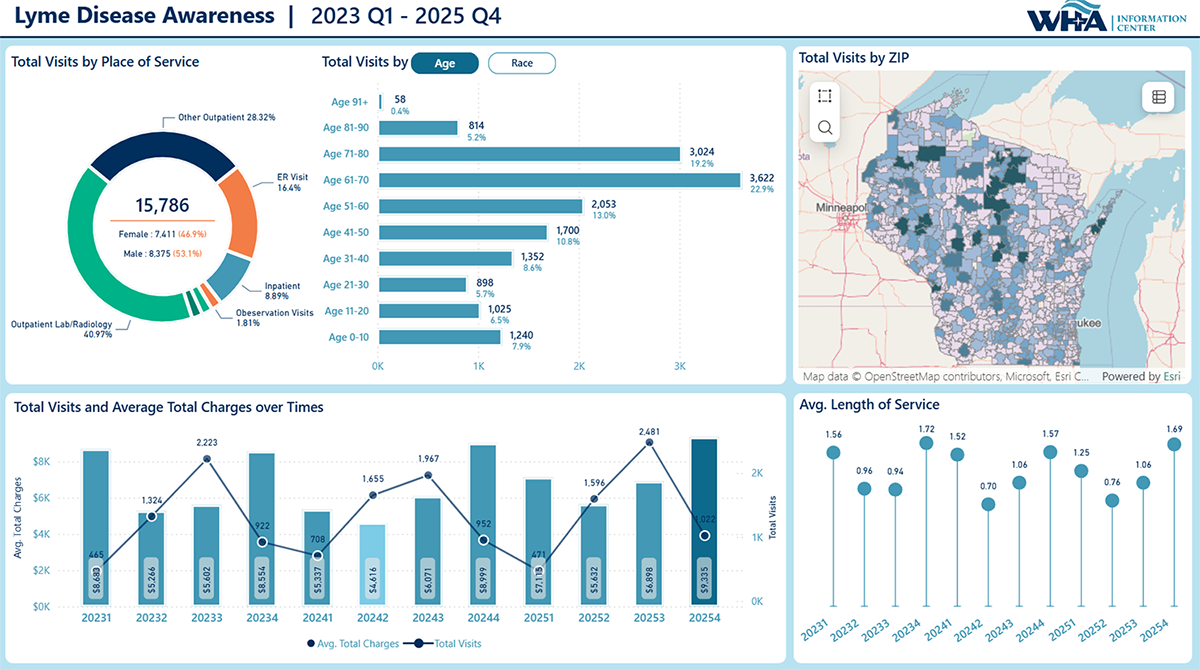
The WHA Information Center analyzed claims for Lyme disease in Wisconsin to see how the state hospital data compares with national trends. When looking at the map of visit counts by ZIP code, it was found that there are more cases reported in northcentral Wisconsin than the rest of the state. Men in the 61-70 age group are the highest demographic diagnosed. The number of visits peaks in the months of July through September.
The following tips from Mayo Clinic will help to prevent tick bites, a cause of Lyme Disease:
- Use tick repellent
- Spray your outdoor clothing, shoes, tent and other camping gear with a repellent that has 0.5% permethrin. Some gear and clothing may be pre-treated with permethrin.
- Use an insect repellent registered with the Environmental Protection Agency on any exposed skin, except your face. These include repellents that contain DEET, picaridin, IR3535, oil of lemon eucalyptus (OLE), para-menthane-diol (PMD) or 2-undecanone.
- Dress for protection
- Wear light-colored clothing that makes it easier for you or others to see ticks on your clothing.
- Avoid open-toed shoes or sandals.
- Wear long-sleeved shirts tucked into your pants.
- Wear long pants tucked into your socks.
- Check for ticks
- Shower as soon as possible to wash off any loose ticks. Check for ticks that may have burrowed.
- Check your gear. Before you wash your outdoor clothes, put them in the dryer on hot for at least 10 minutes to kill ticks.
- Other tips
- Do a daily inspection for ticks on any pet that spends time outdoors.
- Stay on clear paths as much as possible in wooded and grassy areas.
Fast Facts from the WHA Information Center: Lyme Disease
With summer just around the corner, Wisconsinites will be spending more time outdoors enjoying all the season has to offer. While summer is a favorite time of year for many, it's also important to be aware of certain seasonal health risks. Lyme disease is one such concern, affecting both people and pets.
According to The Centers for Disease Control and Prevention (CDC), over 89,000 cases of Lyme disease were reported in 2023, but it’s estimated the number of cases is closer to 476,000. Lyme disease, caused by the borrelia bacteria from ticks, can be found throughout most of the United States. It’s most common in the upper Midwest and the northeastern and mid-Atlantic states in grassy, wooded or brushy areas.
The WHA Information Center analyzed claims for Lyme disease in Wisconsin to see how the state hospital data compares with national trends. When looking at the map of visit counts by ZIP code, it was found that there are more cases reported in northcentral Wisconsin than the rest of the state. Men in the 61-70 age group are the highest demographic diagnosed. The number of visits peaks in the months of July through September.
The following tips from Mayo Clinic will help to prevent tick bites, a cause of Lyme Disease:
- Use tick repellent
- Spray your outdoor clothing, shoes, tent and other camping gear with a repellent that has 0.5% permethrin. Some gear and clothing may be pre-treated with permethrin.
- Use an insect repellent registered with the Environmental Protection Agency on any exposed skin, except your face. These include repellents that contain DEET, picaridin, IR3535, oil of lemon eucalyptus (OLE), para-menthane-diol (PMD) or 2-undecanone.
- Dress for protection
- Wear light-colored clothing that makes it easier for you or others to see ticks on your clothing.
- Avoid open-toed shoes or sandals.
- Wear long-sleeved shirts tucked into your pants.
- Wear long pants tucked into your socks.
- Check for ticks
- Shower as soon as possible to wash off any loose ticks. Check for ticks that may have burrowed.
- Check your gear. Before you wash your outdoor clothes, put them in the dryer on hot for at least 10 minutes to kill ticks.
- Other tips
- Do a daily inspection for ticks on any pet that spends time outdoors.
- Stay on clear paths as much as possible in wooded and grassy areas.
IN THIS ISSUE
- WI Act 115 “Next-of-Kin” Law Takes Effect
- WHA Health Care Leadership Academy Graduate Spotlight: Hannah Young
- Caring for Wisconsin’s Caregivers Steering Committee Advances Year One Success and Prepares for Action
- Johns Receives First Eric Borgerding Health Care Advocacy Scholarship
- Register Today for a Complimentary Webinar on the Impacts to Wisconsin Hospitals on Rising Claims; Strategies for Leaders
- Nominations Open for 2026 Global Vision Community Partnership Award
- Fast Facts from the WHA Information Center: Lyme Disease
EDUCATION EVENTS
Oct. 15, 2026
Substance Use Disorders Management Boot CampOct. 15, 2026
Culture College – Breakthrough Strategies for Creating and Sustaining a Magnetic CultureOct. 20, 2026
WIpop Virtual Training: Session 1