
Click here to view past issues
IN THIS ISSUE
EDUCATION EVENTS
Oct. 15, 2026
Substance Use Disorders Management Boot CampOct. 15, 2026
Culture College – Breakthrough Strategies for Creating and Sustaining a Magnetic CultureOct. 20, 2026
WIpop Virtual Training: Session 1Click here to view education event calendar
View more issues of The Valued Voice
Sign Up for WHA's Newsletter


Fast Facts from the WHA Information Center: April is Parkinson’s Awareness Month
 April is recognized as Parkinson’s Awareness Month. This awareness brings opportunity to increase education about the brain disorder. The National Institutes of Health states that Parkinson’s disease (PD) impacts one’s coordination and balance and can cause shaking and stiffness.
Parkinson’s Foundation writes, “An estimated 1.1 million people in the U.S. are living with Parkinson's disease. This number is expected to rise to 1.2 million by 2030. Worldwide, it’s currently estimated that more than 10 million people are living with Parkinson’s.” Roughly 90,000 people across the country are diagnosed with the disease each year. PD is the second most common neurologic condition found in the United States after Alzheimer’s.
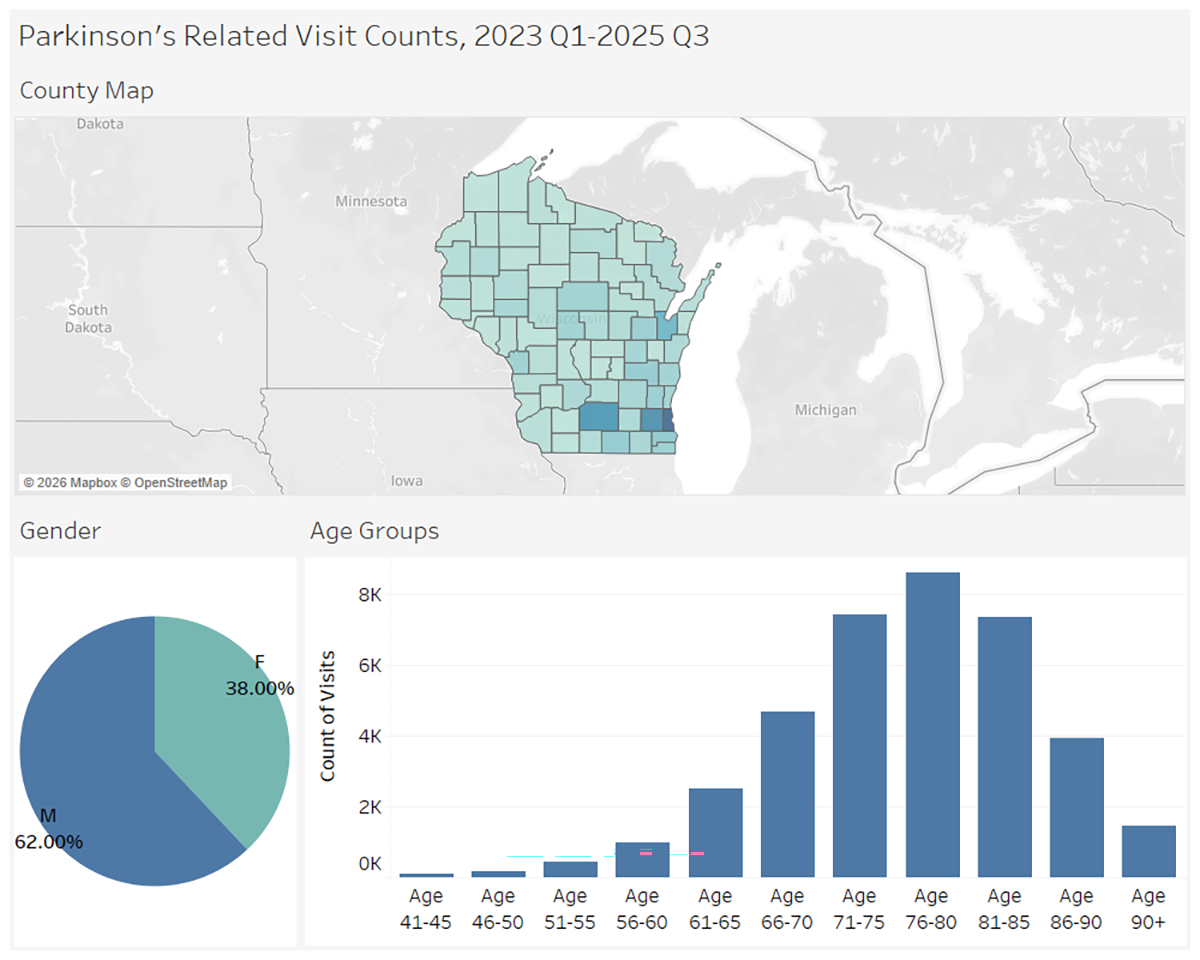
The WHA Information Center analyzed hospital claims from January 2023 to September 2025 and found have a higher visit count than women, aligning with national trends. The average age of a patient visiting for PD is 76 years old, and the age group with the highest number of visits is 76-80 years old.
Below are some National Institute of Neurological Disorders and Stroke’s risk factors:
- Age—The average age of onset is about 70 years, with the incidence rising significantly with older age. However, a small percentage of people with PD have “early-onset” disease that begins before the age of 50.
- Biological sex— Parkinson’s disease affects more men than women.
- Heredity—People with one or more close relatives who have Parkinson’s disease have an increased risk of developing the disease themselves. An estimated 15 to 25% of people with PD have a known relatives with the disease. Some cases of the disease can be traced to specific genetic mutations.
- Exposure to pesticides—Studies show an increased risk in people who live in rural areas with increased pesticide use.
Fast Facts from the WHA Information Center: April is Parkinson’s Awareness Month
April is recognized as Parkinson’s Awareness Month. This awareness brings opportunity to increase education about the brain disorder. The National Institutes of Health states that Parkinson’s disease (PD) impacts one’s coordination and balance and can cause shaking and stiffness.
Parkinson’s Foundation writes, “An estimated 1.1 million people in the U.S. are living with Parkinson's disease. This number is expected to rise to 1.2 million by 2030. Worldwide, it’s currently estimated that more than 10 million people are living with Parkinson’s.” Roughly 90,000 people across the country are diagnosed with the disease each year. PD is the second most common neurologic condition found in the United States after Alzheimer’s.
The WHA Information Center analyzed hospital claims from January 2023 to September 2025 and found have a higher visit count than women, aligning with national trends. The average age of a patient visiting for PD is 76 years old, and the age group with the highest number of visits is 76-80 years old.
Below are some National Institute of Neurological Disorders and Stroke’s risk factors:
- Age—The average age of onset is about 70 years, with the incidence rising significantly with older age. However, a small percentage of people with PD have “early-onset” disease that begins before the age of 50.
- Biological sex— Parkinson’s disease affects more men than women.
- Heredity—People with one or more close relatives who have Parkinson’s disease have an increased risk of developing the disease themselves. An estimated 15 to 25% of people with PD have a known relatives with the disease. Some cases of the disease can be traced to specific genetic mutations.
- Exposure to pesticides—Studies show an increased risk in people who live in rural areas with increased pesticide use.
IN THIS ISSUE
EDUCATION EVENTS
Oct. 15, 2026
Substance Use Disorders Management Boot CampOct. 15, 2026
Culture College – Breakthrough Strategies for Creating and Sustaining a Magnetic CultureOct. 20, 2026
WIpop Virtual Training: Session 1